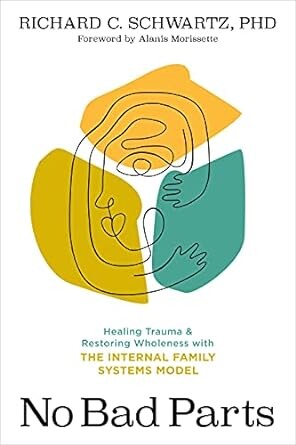
No Bad Parts
Healing Trauma and Restoring Wholeness with the Internal Family Systems Model
By Richard Schwartz
Concepts
- Internal Family Systems (IFS)
- Schwartz's model treating the psyche as an inner community of distinct parts, each with its own perspective and role, rather than a single unified self.
- Parts
- The sub-personalities within the IFS model, categorized as Exiles (wounded parts carrying pain), Managers (preemptive controllers), and Firefighters (reactive protectors that respond to pain when it surfaces).
- Self
- The calm, compassionate, curious, connected core of the person that is distinct from all parts — always present and capable of leading the inner system, even when it has been suppressed by blending.
- Blending
- When a part merges with the Self so completely that a person loses access to their own perspective and acts entirely from the part's fears, beliefs, or impulses.
- Self-Leadership
- The therapeutic goal in IFS: having the Self in relationship with all parts rather than being controlled by them, enabling healing by bringing compassion and curiosity to even the most extreme protective parts.
Chapters
- Foreword by Alanis Morissette
- Introduction
- Part 1. Internal Family Systems
- Chapter 1. We're All Multiple
- Chapter 2. Why Parts Blend
- Chapter 3. This Changes Everything
- Chapter 4. More on Systems
- Chapter 5. Mapping Our Inner Systems
- Part 2. Self-Leadership
- Chapter 6. Healing and Transformation
- Chapter 7. The Self in Action
- Chapter 8. Vision and Purpose
- Part 3. Self in the Body, Self in the World
- Chapter 9. Life Lessons and Tor-Mentors
- Chapter 10. The Laws of Inner Physics
- Chapter 11. Embodiment
- Closing Thoughts
- Acknowledgments
- Notes
- About the Author
Rating
Topics
Published
- July 6, 2021
Publisher
- Sounds True