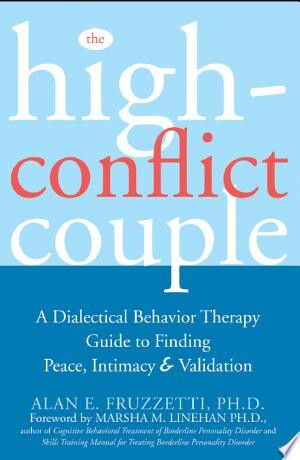
The High-Conflict Couple
A Dialectical Behavior Therapy Guide to Finding Peace, Intimacy, and Validation
By Alan Fruzzetti
Concepts
- Dialectical Behavior Therapy (DBT)
- A therapeutic approach that balances acceptance and change, adapted here for couples to reduce emotional reactivity and build relational skills.
- Dialectical Thinking
- The practice of holding two seemingly opposite truths at once (e.g., "I am doing my best" and "I need to do better"), reducing all-or-nothing thinking that fuels conflict.
- Validation
- Communicating to a partner that their feelings and reactions make sense and are understandable, which de-escalates conflict more reliably than logic or advice.
- Emotional Reactivity
- The rapid, intense emotional responses that hijack communication in high-conflict couples, making skill-building and regulation necessary before communication tools can help.
- Mindfulness in Relationships
- The practice of bringing non-judgmental, present-moment awareness to interactions with a partner, creating the space needed to respond rather than react.
Chapters
- Foreword
- Acknowledgments
- Chapter 1. Understanding Emotion in Relationships
- Chapter 2. Accepting Yourself and Your Partner
- Chapter 3. How to Stop Making Things Worse
- Chapter 4. Being "Together" When You Are Together
- Chapter 5. Reactivating Your Relationship
- Chapter 6. Accurate Expression
- Chapter 7. Validating Responses - What to Validate and Why
- Chapter 8. Validating Responses - How to Validate Your Partner
- Chapter 9. Recovering from Invalidation
- Chapter 10. Managing Problems and Negotiating Solutions
- Chapter 11. Transforming Conflict into Closeness
- References
Rating
Topics
Published
- December 3, 2006
Publisher
- New Harbinger Publications