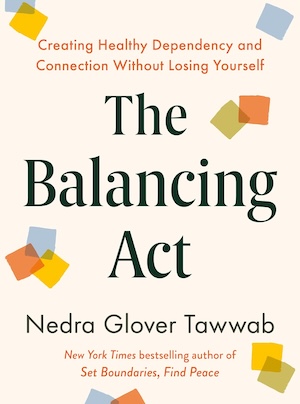
The Balancing Act
Creating Healthy Dependency and Connection Without Losing Yourself
By Nedra Glover Tawwab
Concepts
- The Dependency Spectrum
- Tawwab's framework for understanding dependency not as binary (dependent vs. independent) but as a spectrum ranging from hyper-dependency through healthy dependency to hyper-independence, with the goal of finding a sustainable middle ground.
- Hyper-Independence as a Wound
- The pattern of refusing help, dismissing emotional needs, and insisting on self-sufficiency — often mistaken for strength — reframed as a defensive response to early experiences of abandonment, neglect, or unreliable caregiving.
- Enmeshment vs. Closeness
- The distinction between genuine intimacy, where two people remain separate selves who choose connection, and enmeshment, where boundaries dissolve and one person's identity, emotions, or decisions become fused with another's.
- Parts Work in Relationships
- Drawing on Internal Family Systems (IFS), Tawwab introduces the idea that different internal parts — protectors, wounded parts, and the core self — drive relational behaviour, and that understanding these parts is key to changing patterns.
- Diversified Connection
- The concept that healthy relationships require a broader network of friendships, community ties, and loose social connections, rather than placing all emotional needs on a single partner — reducing pressure and increasing resilience.
Chapters
- Chapter 1. The Spectrum of Unhealthy Dependency
- Chapter 2. The Causes and Effects of Unhealthy Dependency
- Chapter 3. The Fear Factor - Connecting or Disconnecting
- Chapter 4. How the Past Can Show Up in Our Current Bonds
- Chapter 5. The Hyper-Dependent Person and Relationships
- Chapter 6. The Challenges of Enmeshed Relationships
- Chapter 7. The Hyper-Independent Person and Relationships
- Chapter 8. Embracing Vulnerability and Support
- Chapter 9. Pursuing Surface Versus Deep Connections
- Chapter 10. Balancing Independence and Connection
- Chapter 11. The Importance of Care in Love
- Chapter 12. Sustaining Relationships
- Chapter 13. Understanding Our Many Parts
Rating
Topics
- Dependency, Healthy Dependency, Unhealthy Dependency, Hyper-Independence, Hyper-Dependency, Codependency, Enmeshment, Attachment Styles, Anxious Attachment, Avoidant Attachment, Boundaries, Vulnerability, Connection, Independence, Parts Work, Self-Awareness, Community, Friendship, Trust, Needs, Relationships, Social Connections
Published
- February 10, 2026
Publisher
- Piatkus Books
Links